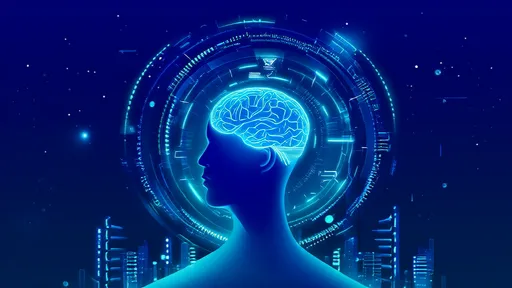
As artificial intelligence continues its relentless march into creative domains, a heated debate has emerged across editorial boards and design studios alike. The central question echoes through conference halls and coffee breaks: are we witnessing the dawn of the ultimate creative assistant or the beginning of the end for human originality? The answer, like most things in this rapidly evolving landscape, proves far more nuanced than either extreme suggests.
The apprehension surrounding AI's creative capabilities often stems from a fundamental misunderstanding of how these systems operate. Unlike humans, AI doesn't experience inspiration in the traditional sense—it doesn't stare at a sunset and feel compelled to write poetry, nor does it suffer heartbreak and channel that pain into music. These systems operate through pattern recognition on an unprecedented scale, analyzing millions of existing creative works to identify and replicate structures, styles, and techniques. The output might resemble creativity, but it's essentially sophisticated recombination based on human-created training data.
Where AI truly shines is in its capacity to handle the tedious, time-consuming aspects of creative work. Graphic designers report using AI tools to generate dozens of layout variations in minutes rather than hours. Writers employ language models to overcome blank page syndrome by generating multiple opening paragraphs before selecting one to develop further. Musicians experiment with AI-generated chord progressions that they might not have considered, using these suggestions as jumping-off points for composition. In these scenarios, AI functions less as a creator and more as an infinite brainstorming partner available at any hour.
The fear that AI might replace human creatives often overlooks the essential human elements that machines cannot replicate. The most powerful creative works throughout history have derived their impact from human experience—the specific cultural context, personal vulnerability, and emotional authenticity that no algorithm can genuinely comprehend or reproduce. AI might generate a technically perfect sonnet, but it will never understand the heartbreak that inspired Shakespeare's verses. It can produce a beautiful landscape painting, but it will never know the awe of actually witnessing that landscape.
Perhaps the most significant impact of AI on creativity lies in its democratizing potential. For centuries, access to creative tools and education has been limited by geography, wealth, and social status. AI tools are rapidly dismantling these barriers. A aspiring filmmaker in a remote village can now use AI-assisted tools to storyboard their vision. A musician without formal training can use AI to help compose and arrange complex pieces. This accessibility doesn't diminish creativity—it expands the pool of creative voices who can participate in cultural conversations.
However, this democratization comes with legitimate concerns about homogenization. If millions of people use the same AI tools trained on similar datasets, will creative output begin to converge toward a algorithmic middle? Early evidence suggests the opposite occurs when humans remain firmly in the creative driver's seat. The most interesting applications of AI creativity emerge when artists use these tools in unexpected ways, bending them to their unique vision rather than simply accepting their default outputs. The true creative potential lies not in what the AI generates automatically, but in how humans choose to manipulate, subvert, and build upon those suggestions.
The relationship between AI and human creativity appears to be evolving toward a collaborative model rather than a competitive one. We're not seeing AI replace artists so much as we're seeing artists who use AI replace those who don't. The creatives thriving in this new landscape are those who've learned to treat AI as another tool in their arsenal—like photographers who embraced digital editing or writers who transitioned from typewriters to word processors. The tool changes, but the essential human creativity at the core remains unchanged.
Looking toward the future, the most exciting developments will likely emerge from the tension between algorithmic suggestion and human intention. As AI systems grow more sophisticated, they'll become better at understanding individual creative styles and preferences, offering increasingly personalized assistance. The creative process may shift from generation to curation, with humans spending more time selecting, refining, and adding meaning to AI-generated options. This doesn't represent the death of creativity but rather its evolution into a new form—one where human judgment and emotional intelligence become more valuable than ever.
Ultimately, the question of whether AI serves as assistant or killer misses the broader point. Technology doesn't determine creative outcomes—people do. The printing press didn't kill storytelling; it expanded its reach. Photography didn't kill painting; it forced painters to explore new artistic territory. Similarly, AI won't kill creativity; it will challenge us to redefine what makes creation meaningful. The most valuable creative works in the AI age will be those that couldn't have been made by either humans or machines alone, but only through the unique synthesis of both.
The narrative surrounding AI and creativity often falls into simplistic binaries that fail to capture the complex reality taking shape in studios and workshops worldwide. The truth is messier and more interesting than either utopian or dystopian forecasts suggest. We're not heading toward a future where machines create instead of humans, but toward one where humans and machines create together—each bringing their unique strengths to the process. The resulting works might bear the fingerprints of both, but the vision, the meaning, and the soul will remain unmistakably human.
By /Aug 21, 2025
By /Aug 21, 2025
By /Aug 21, 2025

By /Aug 21, 2025
By /Aug 21, 2025
By /Aug 21, 2025
By /Aug 21, 2025

By /Aug 21, 2025
By /Aug 21, 2025
By /Aug 21, 2025

By /Aug 21, 2025
By /Aug 21, 2025
By /Aug 21, 2025
By /Aug 21, 2025
By /Aug 21, 2025
By /Aug 21, 2025
By /Aug 21, 2025
By /Aug 21, 2025
By /Aug 21, 2025
By /Aug 21, 2025